Crawl Space Radon Mitigation: Sealing the Dirt Under the Floor
Crawl space radon mitigation takes more preparation than a basement job, because there is no concrete to pull suction under. The answer is a plastic floor that does the job of a slab.
In a crawl space the installer covers the dirt with plastic sealed to the walls and piers, then a fan draws soil gas from under that sheet and vents it above the roof. EPA calls this sub-membrane suction the most effective method for crawl space homes. Bob Vila (2022) lists it at $800–$3,000.
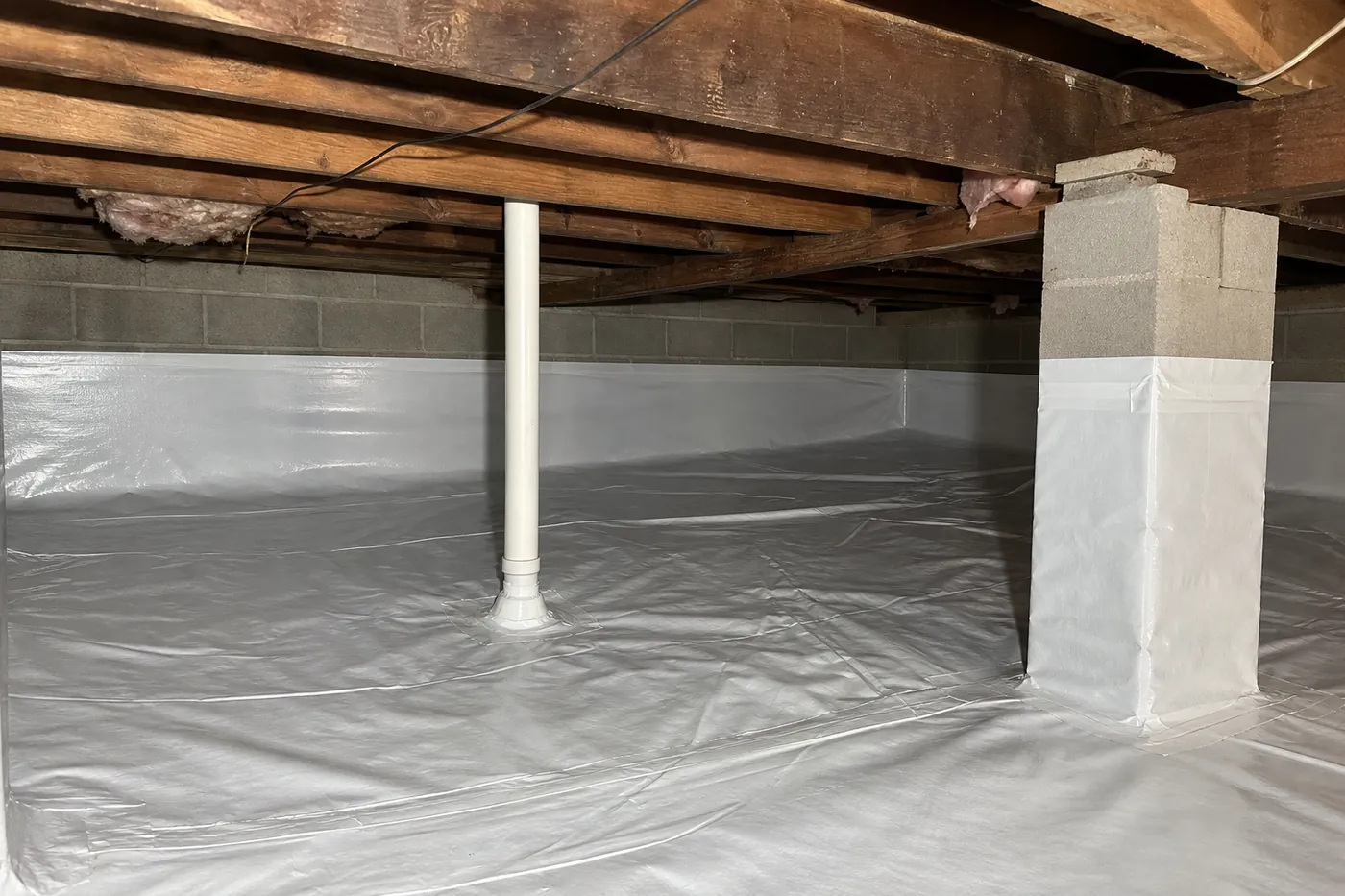
Why can't a crawl space use plain sub-slab suction?
Sub-slab suction works because concrete holds the vacuum in place. A dirt floor has nothing to hold it, so a fan would mostly pull house air down and out. Ohio's mitigation standards therefore require a soil gas retarder, a plastic membrane, in any basement or crawl space area without a concrete floor. EPA ranks the alternative, depressurizing the whole crawl space with a fan, as less effective and harder on heating and cooling bills, and Ohio allows it only where the space is too tight for a rescuer to reach.
What does Ohio require of the membrane?
- Material. At least 6-mil polyethylene or an equivalent such as 3-mil cross-laminated sheet, and heavier sheeting where the space is used for storage or entered often to service equipment.
- Seams. Overlapped at least 12 inches and sealed airtight with a compatible glue.
- Edges. Sealed to the inside of the foundation walls and around each pier with furring strips or another permanent fastener. Wood touching soil or concrete must be pressure treated or naturally rot resistant.
- Access doors. Gasketed and able to close tight, but never sealed shut.
What if the house has a crawl space and a basement?
Mixed foundations are common: a basement under the original house and a crawl space under an addition, or a slab room built on later. EPA notes these often need a combination of methods, such as sub-slab suction in the basement tied to a membrane in the crawl. Ohio's standards let the opening between the two areas stay unsealed when both are mitigated together. Ask the specialist to mark every area on the floor-plan drawing Ohio requires before work starts.
Is the old plastic down there good enough?
Rarely. Many crawl spaces already have loose plastic laid for moisture. Unless it is sealed at the seams, walls and piers, it does not meet Ohio's membrane rules and will not hold suction, so an installer may lay new sheet over it or replace it. A dehumidifier or an encapsulation sold for moisture is a separate job; a radon system is defined by the sealed sheet, the suction pipe and the fan. Typical prices for each method are in the Columbus radon mitigation cost guide.
Questions homeowners ask
Does crawl space encapsulation take care of radon?
Not by itself. A sealed liner slows soil gas, but EPA's recommended fix for crawl spaces is sub-membrane suction: a fan and pipe drawing from under the sealed sheet. If you are planning encapsulation for moisture anyway, ask whether a radon suction point can be built in at the same time, and test again afterward either way.
Tell us where things stand
Share what you know so far: a test result, a closing date, or just the kind of foundation the house sits on. One independent radon mitigation specialist who works around Columbus gets back to you about next steps.