National cost guides, named and dated
Radon Mitigation Cost in Columbus: What the Guides Report
Radon mitigation cost in Columbus depends less on the test number than on the house: the foundation, how easily air moves under the slab, and where a pipe can run to clear the roof. The ranges below come from three national guides, Thumbtack, Fixr and Bob Vila, so you can tell whether a written proposal sits in a normal band.
Thumbtack's 2026 guide puts a typical radon mitigation system at $748–$1,529, with most people paying about $1,071. Fixr (2025) gives $650–$2,850 for testing plus mitigation, and Bob Vila (2022) lists crawl space membrane systems at $800–$3,000. All are national figures.
Radon mitigation cost in Columbus, by system and task
| Item | Typical range | Published by | What moves it in a Columbus house |
|---|---|---|---|
| Typical mitigation system, installed | $748–$1,529 (most pay about $1,071) | Thumbtack, 2026 | One suction point under a basement slab sits at the low end |
| Testing plus mitigation, whole project | $650–$2,850 (average $1,700; high end $5,900) | Fixr, 2025 | Tests before and after; number of suction points |
| Active sub-slab suction | $500–$2,500 | Fixr, 2025 (Bob Vila, 2022: $800–$2,500) | How easily air moves through the fill under the floor |
| Sealed sump system | $800–$2,500 | Bob Vila, 2022 | Ohio wants an airtight lid with a view-port |
| Drain tile suction | $800–$1,700 or more | Bob Vila, 2022 | Whether a perimeter drain loop already exists |
| Block-wall suction | $1,500–$3,000 | Bob Vila, 2022 | Hollow block walls; usually added to sub-slab suction |
| Crawl space sub-membrane system | $800–$3,000 | Bob Vila, 2022 | Floor area, piers to seal around, sheet thickness |
| Basement sealing alone | $3,000–$5,000 | Fixr, 2025 | Not recommended as the fix by EPA or ODH |
| Replacement radon fan | $100–$300 or more | Bob Vila, 2022 | Fan model and how hard it is to reach |
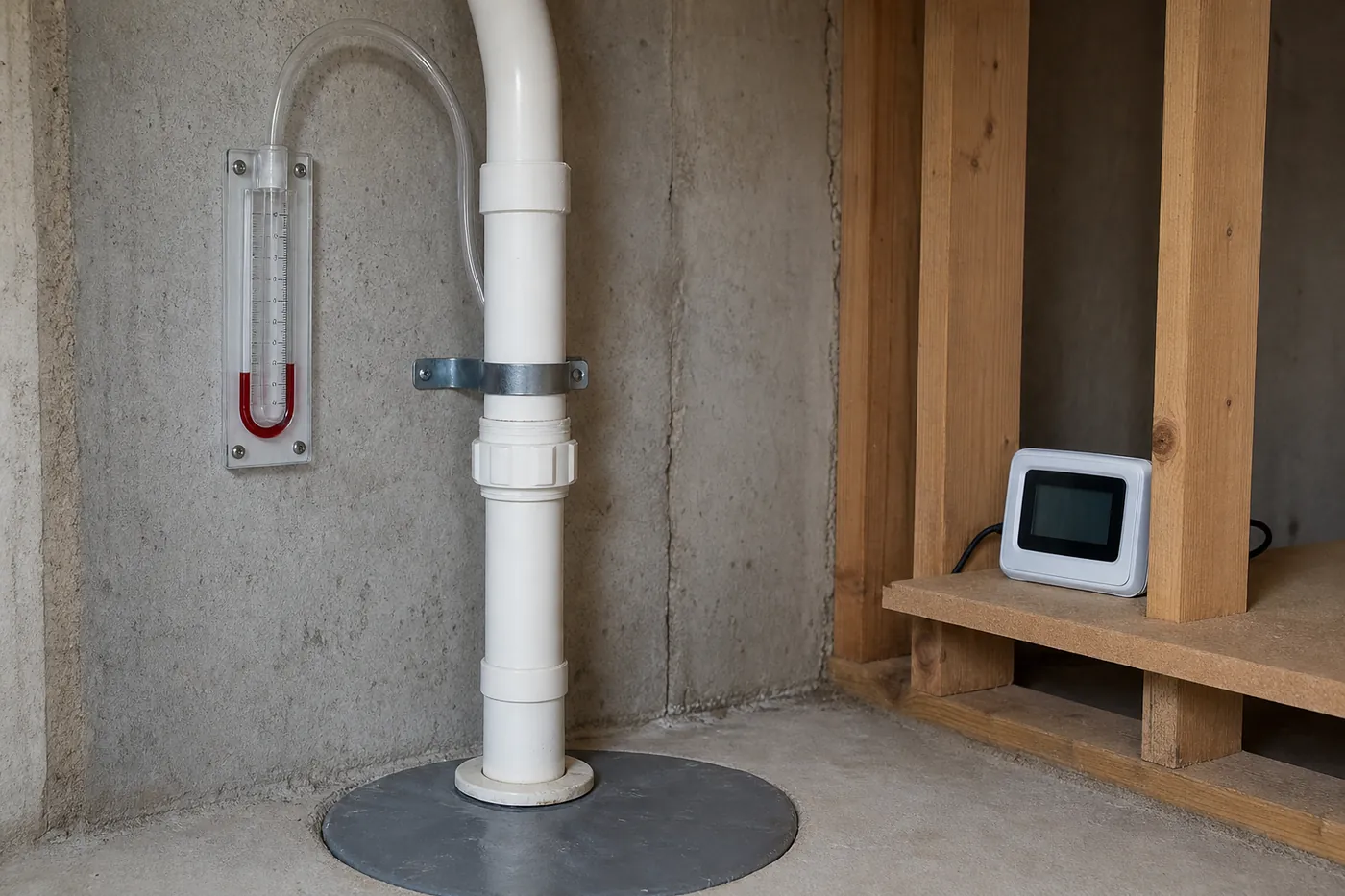
What moves radon mitigation cost in a Columbus house?
- Foundation type. A basement or slab usually takes one suction pipe through the floor. A crawl space needs a sealed membrane first, and Thumbtack notes those homes cost more. Houses that mix a basement with a crawl space or slab addition may need both.
- What sits under the slab. Ohio's standards call for a communication test when the material under the floor is unknown. Tight fill can mean a second or third suction point.
- The pipe route. The exhaust must end above the highest eave and at least 10 feet from any window or door less than 2 feet below it (Ohio Radon Mitigation Standards). Routing the pipe up through a garage and attic keeps it off the siding but usually takes more labor than a run up an outside wall.
- The sump. With 58% of Ohio homes on basements (U.S. Energy Information Administration), many have a sump pit, which must get an airtight lid with a view-port.
- Age of the house. Half of Columbus homes were built before 1980 (Census Bureau, 2020–2024 American Community Survey). Older floors tend to have more cracks and openings, and Ohio's standards require them sealed as part of the job.
What does a radon system cost to run?
A fan system runs all the time; EPA says it should never be switched off. Bob Vila (2022) estimates a running fan adds $30–$300 a year to the energy bill, depending on the fan and local power rates, and EPA notes most systems also draw out a little heated or cooled air. Fans may last five years or more, and manufacturer warranties tend not to exceed five years (EPA); a replacement fan runs $100–$300 or more in Bob Vila's figures. Budget for a retest at least every two years, as ODH recommends: Fixr lists short-term tests at $20–$350.
Reading an Ohio radon mitigation proposal
Ohio's mitigation standards (the appendix to Ohio Administrative Code 3701-69-08) list what a written proposal must contain, which makes two bids easy to line up. Check that each one has:
- the Ohio license numbers of the mitigation specialist and the contractor;
- the scope of work and an estimated completion date;
- the installation price and an estimate of the yearly operating cost;
- any upkeep you will be expected to do;
- either a statement that the system is guaranteed to bring the average below 4 pCi/L, with its conditions, or an explanation of why there is no guarantee;
- a disclosure if the same company tested your house.
Then compare the practical choices: where the fan sits, how the pipe reaches the roof, and how the sump is handled.
Where these numbers come from, and their limits
No public agency publishes what Columbus radon contractors charge, so every figure on this page is national and named. The three guides compile their data separately and land close together for a basic system: $748–$1,529 in Thumbtack's 2026 data, and a $978 average in the HomeAdvisor figures Bob Vila cited in 2022. EPA's own guide says most homes can be fixed for about the same cost as other common home repairs. When a proposal lands far above these bands, that alone does not make it wrong; ask the specialist which feature of your house pushed it there.
Cost questions
Why do two radon quotes for the same Columbus house differ?
Usually because the contractors plan different systems. One may expect a single suction point and a pipe up the outside wall; another may plan two points, an attic route or a crawl space membrane. Ohio requires a visual inspection and a floor-plan sketch before a written proposal, so ask each one to show the suction points, fan location and pipe route.
Does a crawl space cost more to mitigate than a basement?
Often, yes. A crawl space needs a sealed plastic membrane before suction can work, and Bob Vila's 2022 figures put sub-membrane systems at $800–$3,000, against $800–$2,500 for sub-slab suction. Thumbtack also notes that crawl space homes cost more. A house with both a basement and a crawl space may need the two methods tied together.
Can a passive radon pipe be upgraded instead of starting over?
Often it can. Radon-resistant construction, as the Ohio Department of Health describes it, runs a vent pipe from gravel under the slab up through the roof and leaves an attic outlet for a fan, and ODH says a fan can easily be added if a test comes back high. Ask the specialist to check that pipe before pricing a whole new system.
Tell us where things stand
Share what you know so far: a test result, a closing date, or just the kind of foundation the house sits on. One independent radon mitigation specialist who works around Columbus gets back to you about next steps.